Modern engineering applications increasingly require components that combine strength, dimensional accuracy and repeatability. Closed Die Forging is an effective manufacturing process for producing such components.
In closed die forging, heated metal is placed between specially designed dies that contain the required component geometry. Pressure is then applied to force the material into the die cavity.
What Is Closed Die Forging?
Closed die forging, also known as impression die forging, shapes heated metal inside a die cavity. The die determines the external geometry of the component, allowing manufacturers to achieve repeatable shapes and complex profiles.
How Closed Die Forging Works
The manufacturing process generally involves the following stages:
- Selecting suitable raw material — Choosing the appropriate metal grade to match service conditions.
- Cutting the material — Sizing billets to precise volume for clean cavity filling.
- Heating — Bringing the workpiece to the precise forging temperature range.
- Positioning the material — Aligning the preheated billet in the bottom die impression.
- Applying controlled forging force — Delivering hydraulic or mechanical impact energy.
- Filling the die cavity — Forcing plastic metal into every contour and groove.
- Removing excess material — Trimming flash where required.
- Heat treatment — Normalizing, quenching, or tempering to attain specified tensile and impact ratings.
- Machining — Proof or finish machining critical mating surfaces and bores.
- Final inspection — NDT, dimensional, and metallurgical testing against standards.
Advantages of Closed Die Forging
Closed die forging provides major operational and engineering benefits:
- Excellent repeatability — Consistent tolerances across batch production runs.
- Consistent component geometry — Near-net-shape accuracy part after part.
- Efficient material utilization — Minimal raw material waste compared to subtractive machining.
- Superior mechanical properties — Continuous grain flow aligned with operating stresses.
- Reduced machining requirements — Less post-forge material removal required for complex profiles.
- Capability for complex profiles — Producing intricate cross-sections not possible in open dies.
- High production efficiency — Optimized cycle times for high-demand component schedules.
Open Die vs Closed Die
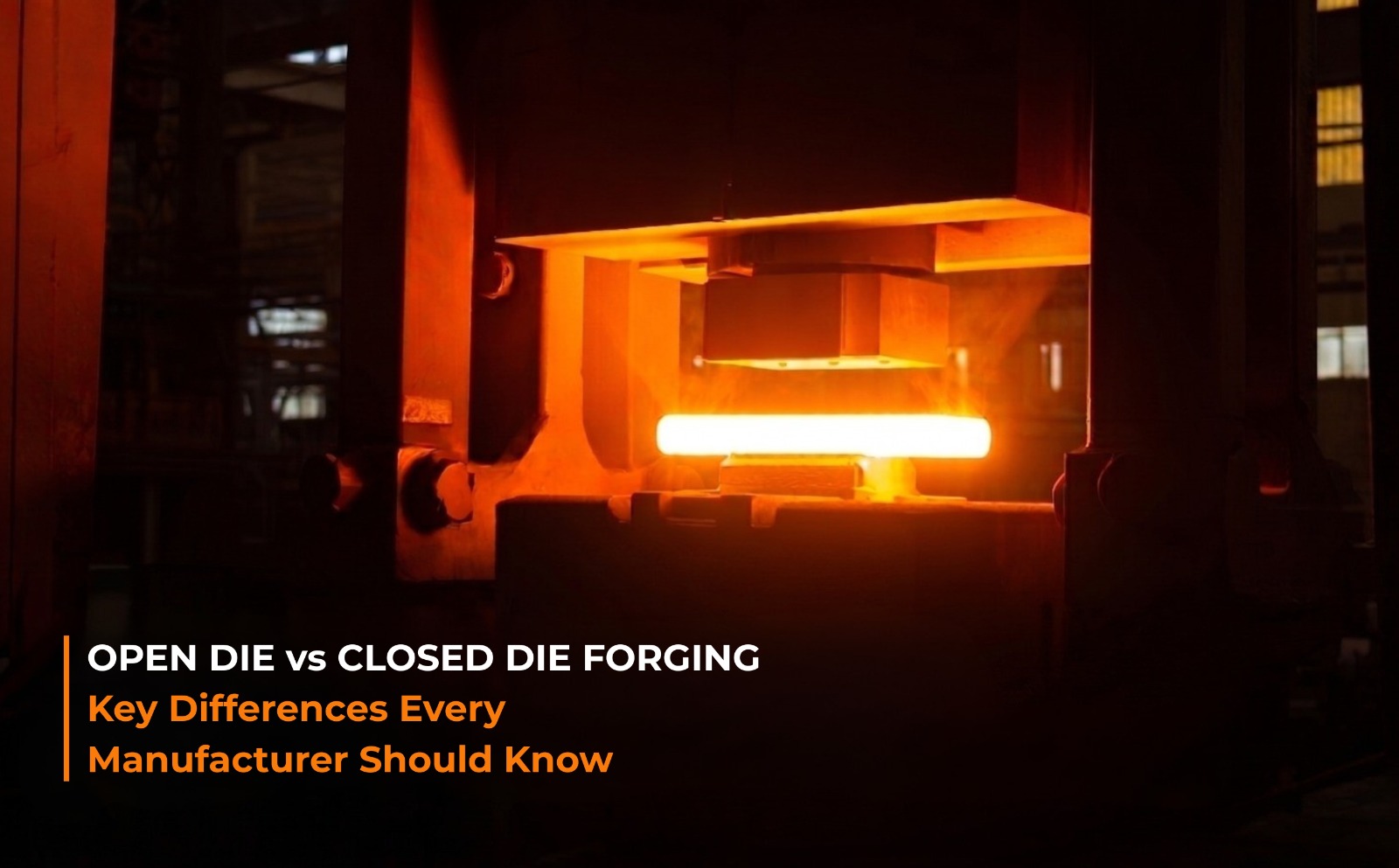
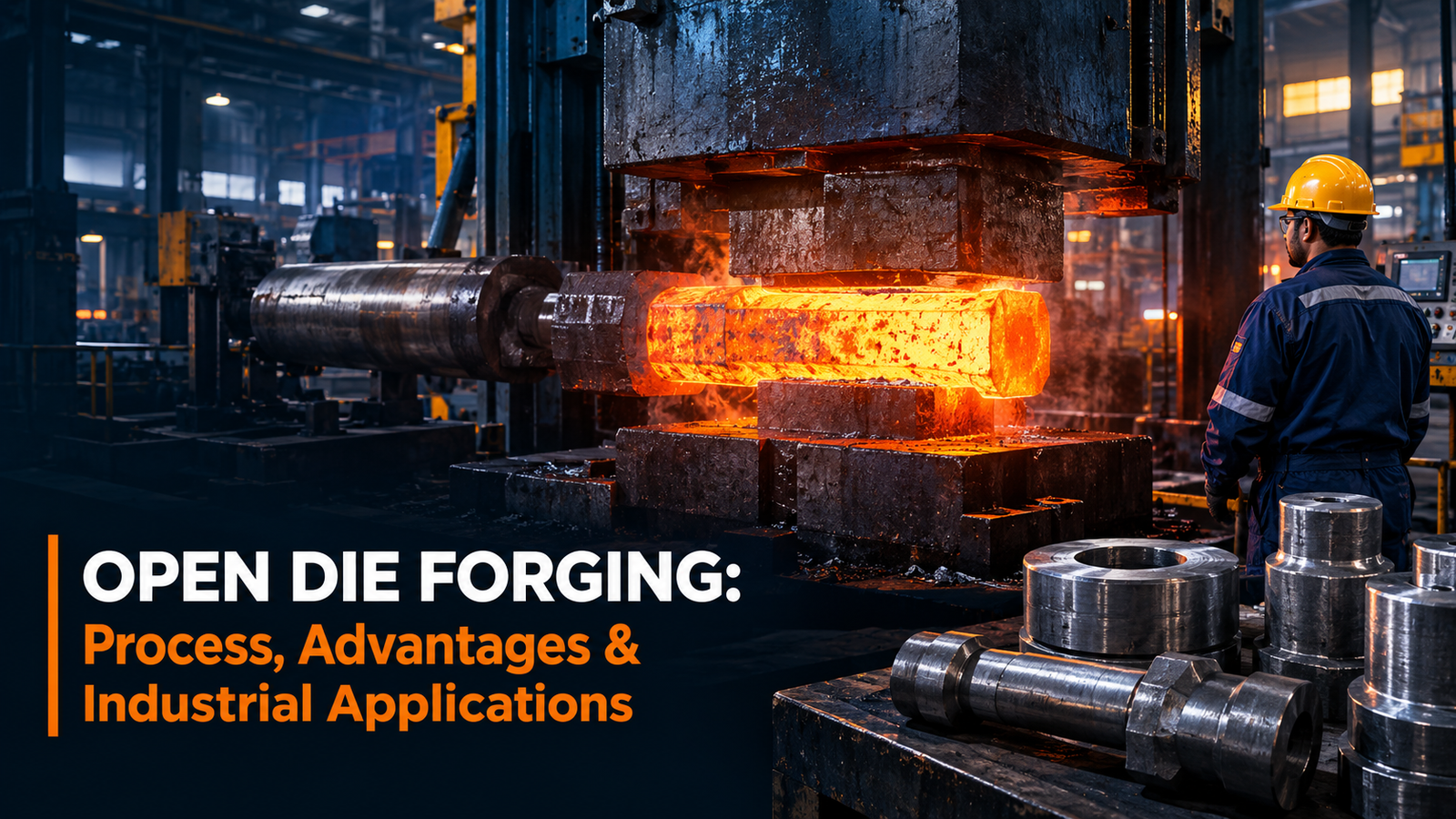
Open die forging offers greater flexibility for larger, heavy-duty, and customized components without requiring dedicated tooling. On the other hand, closed die forging is particularly advantageous where high repeatability, defined geometries, and tight tolerances are paramount.
The choice between open die and closed die forging depends on component geometry, material grade, overall dimensions, required quantity, tolerances, and application specifications.
Applications
Closed die forged components serve mission-critical roles across high-stress industrial applications:
- Automotive — Crankshafts, connecting rods, steering knuckles, gears, and driveline components.
- Industrial Machinery — Heavy-duty linkages, brackets, and high-load transmission parts.
- Engineering Equipment — Pressure-retaining bodies, structural brackets, and specialized fittings.
- Power Transmission — High-torque hubs, planetary gears, and shaft couplings.
- Defence — High-impact vehicle chassis components, ordnance housings, and suspension linkages.
- Construction — Earthmoving track links, excavator teeth holders, and hydraulic cylinder heads.
- Other Critical Engineering — Applications requiring zero-defect reliability under cyclical loads.
Forgewell Industries Capabilities
With the addition of Closed Die Forging to its manufacturing capabilities, Forgewell Industries can support customers with both flexible open die solutions and precision-oriented closed die requirements.
Forgewell Industries — Strength Forged. Precision Delivered.